
Duct Rodder
Description: A duct rodder is a fundamental manual tool used by technicians and installers to establish pathways through underground conduits,ducts,and pipes.It serves as the critical first step in pulling or blowing cables for telecommunications,fiber...
Mobile:+86 13716380533
Email:Charlestools086@hotmail.com
Product Description:
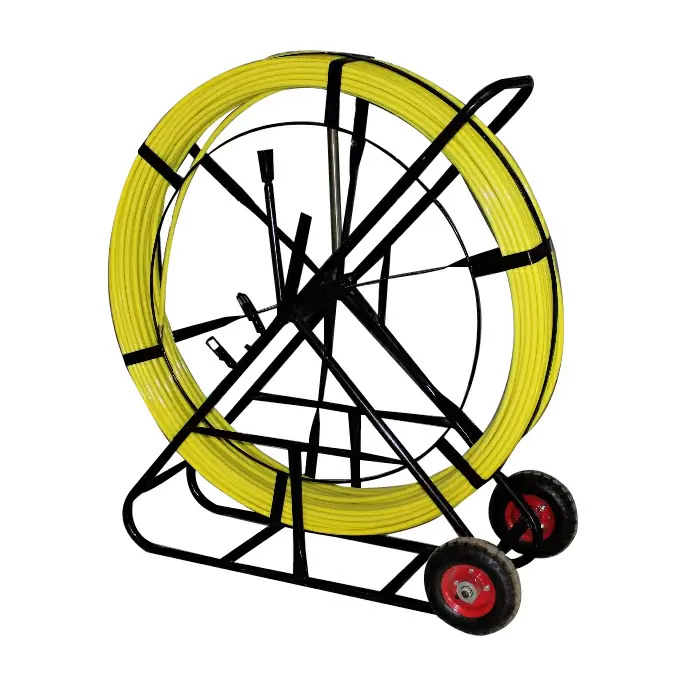
A duct rodder is a fundamental manual tool used by technicians and installers to establish pathways through underground conduits,ducts,and pipes.It serves as the critical first step in pulling or blowing cables for telecommunications,fiber optics,electrical,and utility networks.
Core Function&Design:
Its primary purpose is to navigate empty or existing conduits to install a pull line(mule tape,rope,or draw wire).This pull line is then used to safely and efficiently install the actual cable.The tool itself typically consists of a long,flexible,yet rigid rod made from fiberglass(GFRP)or,for shorter runs,durable polypropylene.These materials provide an excellent balance of strength,flexibility,and non-conductivity for safety.
Key Components:
The Rod:Available in various diameters(commonly 4mm to 12mm)and lengths(standard coils of 30m,60m,100m,or more).Lengths can be joined via couplers for longer runs.
Nose Cone/Tip:A smooth,rounded tip attached to the leading end.This guides the rod through the duct,helps navigate bends,and prevents snagging.
Pulling Eye/Swivel:Integrated at the tip or attached behind it,this component allows for the secure attachment of a pull line or swivel,preventing damaging twists during the cable pull.
How It Works(The Process):
Preparation:The conduit is checked for major blockages.
Rodding:The technician manually pushes or feeds the flexible rod into the duct opening,navigating its path through bends.
Line Attachment:Once the rod emerges at the target exit point,a pull line is securely attached to its leading eye.
Line Pull-Through:The rod is then carefully retracted,pulling the line back through the entire conduit run.
Cable Installation:The secured pull line is finally used with appropriate grips and lubricant to mechanically pull the permanent cable through the duct.
Primary Applications:
Pre-installation Pathway Creation:Establishing a route in new,empty ducts before cable installation.
Fault Finding&Clearing:Locating blockages and sometimes clearing minor debris.
Pull Line Replacement:Replacing damaged or old pull lines within existing infrastructure.
Direct Cable Rodding:For very short distances or lightweight cables,the cable can sometimes be attached directly to the rodder.
Advantages:
Simplicity&Reliability:A straightforward,mechanical solution requiring no external power in most cases.
Cost-Effectiveness:Essential for avoiding costly and disruptive excavation by enabling trenchless installation.
Versatility:Effective in various duct materials(PVC,HDPE,clay)and for multiple cable types.
Safety:Non-conductive materials protect technicians when working near live utilities.
Important Usage Considerations:
Duct Condition:Works best in clear,unobstructed conduits.Severely blocked or collapsed ducts may require other methods.
Bend Radius:Excessive bends or kinks in the conduit can halt progress or damage the rod.
Tension&Force:The rod must not be over-pushed or over-pulled,as it can break or buckle.Proper technique is key.
Lubrication:Cable pulling lubricant is almost always required in the subsequent cable pull phase,though not typically during initial rodding.
In essence,the duct rodder is the indispensable workhorse of the cabling industry.It solves the fundamental challenge of"how to get a line from point A to point B through a buried pipe,"forming the critical first link in the chain of any conduit-based cable installation project.
-

Troubleshooting of common faults in the construction of fiberglass threading equipment
2026-01
-
Common usage issues of fiberglass threading device
2026-01
-
Application technical requirements of fiberglass threading device in complex working conditions
2026-01
-
Installation, use, and daily maintenance of fiberglass cable connectors
2026-01